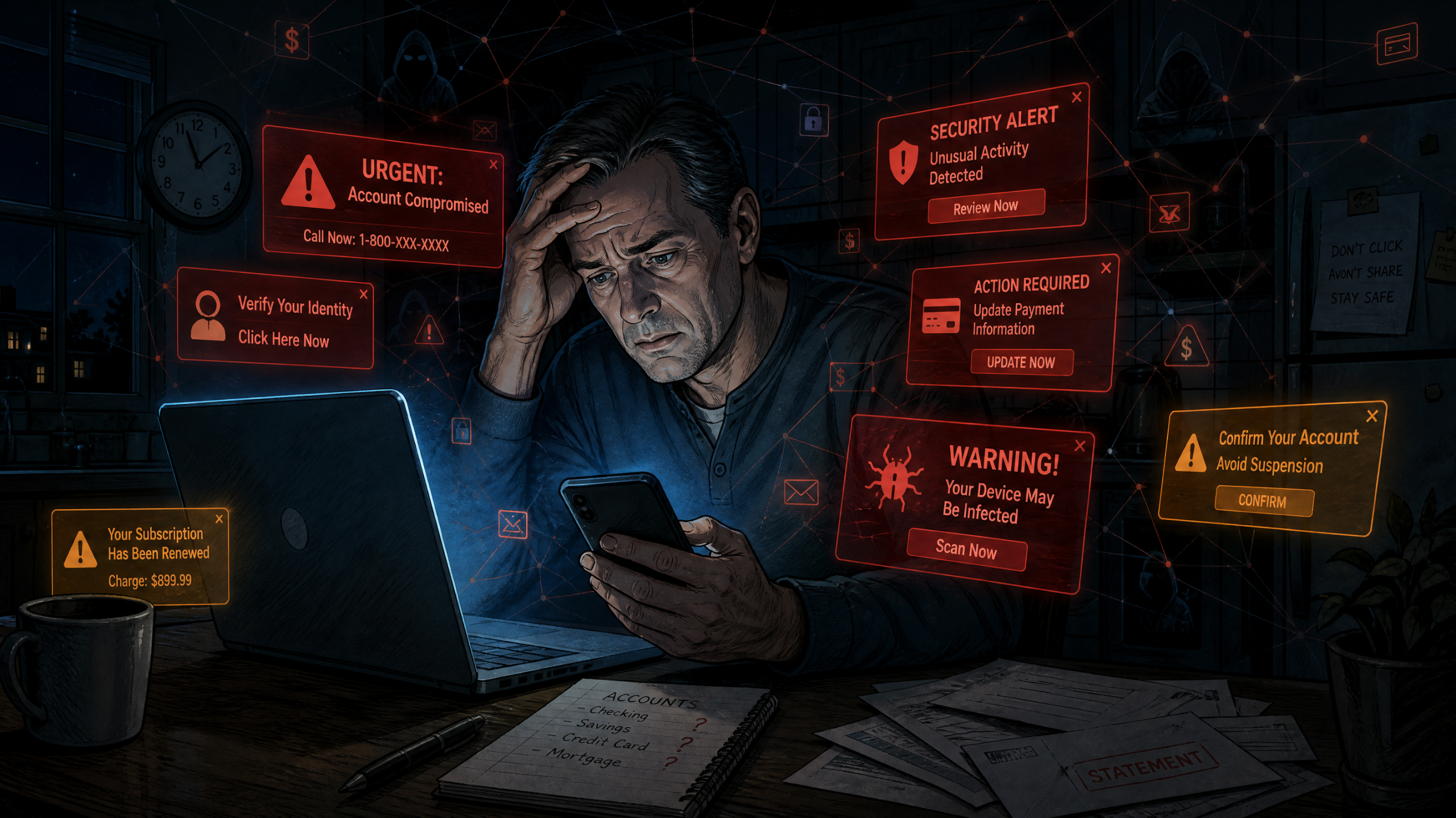
First, let go of the idea that scam victims are careless or naive. The FTC’s data tells a different story: people in their twenties report losing money more often than people over seventy, and older adults who get hit tend to lose far more per incident. Scams reach across every age, income, and education level, because they don’t exploit stupidity — they exploit trust, fear, urgency, and the ordinary distraction of a busy day. The shame that keeps so many victims silent is itself part of the problem; experts believe the real losses dwarf even the reported ones, because most people are too embarrassed to come forward. Knowing how these work isn’t a luxury. It’s basic literacy now.
The Scams Surging Right Now
1. Imposter scams — the reigning champion
Year after year, impersonation is the single most-reported fraud, and in 2024 people lost nearly $3 billion to it. The formula is always the same: someone contacts you unexpectedly, pretending to be an authority you’d never question. The FTC lists the favorites — the government (claiming you owe a fine or a toll), your bank (warning of a problem with your account), a well-known business like Amazon, or someone you know, like a grandchild in trouble. Whatever the costume, the goal is to rush you into sending money or handing over personal information before you stop to think. The FTC’s one-line rule is worth tattooing on your brain: don’t give money or personal information to someone who contacts you unexpectedly.
2. The unpaid-toll text
If you’ve gotten a text claiming you owe a few dollars in unpaid tolls, you’re not alone — it has become one of the most widespread scams in the country. The FTC reports that government imposter scams jumped 40%, driven in large part by these messages. They spoof real toll programs like E-ZPass, SunPass, FasTrak, and TxTag to look credible, and they threaten late fees or a suspended vehicle registration if you don’t pay immediately. The link leads to a fake page that harvests your card details. The defense is simple: if you think you might actually owe a toll, contact your state’s toll agency using a number or website you look up yourself — never the link in the text.
3. The “is this you?” bank fraud alert
This one is devious because it wears the costume of safety. You get a text that looks like a fraud alert from your bank or from Amazon: “Did you just spend $500? Reply YES or NO.” The moment you respond — or call the number they give — a friendly “fraud department” agent takes over and walks you, step by stressful step, into draining your own account, often by convincing you to move your money to a “safe” account that belongs to them. The FTC notes that texts have an open rate as high as 98%, which is exactly why scammers love them. Real fraud departments don’t operate this way. If you get one of these, don’t reply and don’t call the number in the message — call the number printed on the back of your card instead.
4. Task and job scams — the fastest-rising threat
This category exploded faster than almost any other. The FTC found that losses to job and employment-agency scams rocketed from $90 million in 2020 to over $500 million in 2024. The newest version is the task scam: an unsolicited text from a “recruiter” offers easy money for simple, repetitive online tasks — rating products, liking videos, “optimizing” apps. At first it even seems to pay. Then comes the trap: to “unlock” your earnings or reach the next level, you’re asked to deposit your own money, usually in cryptocurrency. That money vanishes, and so do the “earnings.” The tell is the shape of the offer itself: a real job does not arrive as a random text, does not pay you to tap buttons, and never asks you to pay them to get paid.
5. Investment and crypto scams
In raw dollars, nothing else comes close: investment scams cost Americans $5.7 billion in 2024, the single largest loss category, up 24% in a year. Many follow a pattern sometimes called “pig butchering” — a stranger strikes up a warm, patient friendship (often starting with a “wrong number” text or a social-media message), gradually earns your trust over weeks, then introduces a too-good investment opportunity, usually in crypto, on a slick platform that’s entirely fake. Early “gains” on the screen lure you to invest more, and when you try to cash out, the money is gone. The warning signs are guaranteed or unusually high returns, pressure to act fast, and any “opportunity” that reaches you through an unexpected message from someone you’ve never met in person.
6. Romance scams
Romance scams are uniquely cruel because they steal your heart before your money. The FTC reports these on the rise, with losses up 22% and a staggering median of roughly $2,020 per person. The script: a charming match on a dating app or social platform showers you with affection, builds an intense connection fast, but always has a reason they can’t meet in person or video-chat — and eventually, an emergency that requires your financial help. They’ll often push to move the conversation off the dating app to a private channel early on. The hard truth to remember: anyone you’ve never met in person who professes love and then asks for money is running a scam, no matter how real the feelings seem.
7. The AI voice-clone “family emergency”
This is the newest and most frightening twist. Using just a few seconds of audio scraped from social media, scammers can now clone a person’s voice. The FTC warns of the family-emergency version: you get a call that sounds exactly like your child or grandchild, panicked, saying they’ve been in an accident or arrested and need money wired right now. The voice is fake, but the panic it triggers is real, and that panic is the weapon. The defense is to do the one thing the scammer is desperate to prevent: hang up and call your loved one back directly on their own number. Better still, agree on a family code word now — a secret only real family members know — so that any genuine emergency call can be instantly verified.
8. Online shopping scams
Among the most commonly reported frauds is the simple fake storefront. A slick social-media ad offers a coveted item at an unbelievable price; you pay, and either nothing arrives or you receive a worthless knockoff — and the “store” vanishes. These thrive on impulse and scarcity (“today only,” “almost sold out”). Before buying from an unfamiliar shop you found through an ad, search its name alongside the word “scam,” look for real reviews and contact details, and pay with a credit card, which offers far stronger fraud protection than a bank transfer or payment app.
Red Flags That Cut Across Every Scam
⚠ You were contacted out of the blue — a text, call, DM, or email you didn’t initiate.
⚠ There’s urgency or a threat — act now, or face arrest, fees, or a lost opportunity.
⚠ An unusual payment is demanded — gift cards, crypto, wire transfer, or a payment app.
⚠ You’re told to keep it secret or not to tell your bank, family, or the police.
⚠ It’s too good to be true — easy money, guaranteed returns, a prize you didn’t enter.
The Three Tells Every Scam Shares
Here’s the liberating part: you don’t have to memorize every scam, because nearly all of them share the same three-part DNA. Learn to spot the pattern and you’ll catch even brand-new scams you’ve never heard of.
One: unexpected contact. The scam reaches you — you didn’t call them, apply, or sign up. Two: manufactured urgency. Something terrible or wonderful will happen unless you act immediately, a deadline designed to stop you from thinking or checking. Three: an unusual way to pay. They want money moved through a channel that can’t be reversed — gift cards, cryptocurrency, a wire transfer, or a peer-to-peer payment app. When a single message carries all three of these, you are looking at a scam. Full stop. No further analysis needed.
The Payment Method Is the Dead Giveaway
If you take just one idea from this article, make it this one. Scammers overwhelmingly demand payment in forms that are fast and nearly impossible to claw back — which is exactly why the FTC found that in 2024, people lost more to bank transfers and cryptocurrency than to all other payment methods combined ($2 billion via bank transfer, $1.4 billion via crypto). No legitimate government agency, bank, utility, or business will ever demand that you pay a bill, a fine, or a fee with gift cards, cryptocurrency, a wire transfer, or a payment app. Not one. So the instant anyone — the “IRS,” the “power company,” a “fraud investigator” — insists on one of those, you can stop worrying about whether the rest of the story is convincing. The payment request alone has already told you it’s a scam.
Your Universal Defense: Stop and Verify
Every scam in this article dies the same way: you refuse to act on the contact information the scammer gave you, and verify through a channel you trust instead. When a message creates pressure, that pressure is your cue to slow down, not speed up. Hang up the call, close the text, ignore the link. Then, if there’s any chance it could be real, reach the organization yourself — type your bank’s address into your browser, call the number on your statement, log into your account directly, or phone your family member on the number you already have for them. The scammer’s entire plan depends on you trusting the path they provided. Take a different path and the whole thing collapses.
Pair that with a few standing rules and you’re remarkably well protected: never pay anyone in gift cards or crypto on demand; never give personal or financial details to someone who contacted you first; and treat any “act now or else” deadline as a reason to do the exact opposite and pause. None of this requires technical skill. It requires only the discipline to take thirty seconds when someone is working very hard to make sure you don’t.
If You’ve Already Been Hit
If it’s happened to you, move fast and skip the shame — remember, of everyone who reported fraud to the FTC, 38% lost money. You’re in enormous company. Speed matters most: contact your bank, card issuer, or the payment app immediately to try to stop or reverse the transaction; the sooner you call, the better your odds. If you gave up a password, change it and turn on multi-factor authentication right away, on every account that shared it. Report the scam to the FTC at ReportFraud.ftc.gov and to the FBI’s Internet Crime Complaint Center at ic3.gov — reporting genuinely helps investigators and sometimes helps freeze stolen funds. And if you handed over sensitive identity details like your Social Security number, go to IdentityTheft.gov for a step-by-step recovery plan. Payments sent by gift card, wire, or crypto are the hardest to recover, but report them anyway and quickly — occasionally fast action still makes a difference.
Protect the People Most at Risk
The single most caring thing you can do with this information is share it. Older relatives, in particular, tend to lose far more when they’re targeted, and the voice-cloning and grandparent scams are aimed straight at them. Have the conversation now, before a scammer does: explain that the bank and the government will never demand gift cards or crypto, that a panicked “grandchild” call should always be verified by hanging up and calling back, and that no real opportunity arrives by surprise text. Set up a family code word together. Make it clear — warmly and often — that if anything ever feels off, they can call you first, with zero judgment. A scammer’s greatest ally is a victim who’s too rushed, too scared, or too embarrassed to check with someone. Be the someone they check with.
Slow Down. That’s the Whole Trick.
Scams reached a record $12.5 billion in a single year not because people got more gullible, but because the cons got better — more personal, more polished, more relentless. They arrive on the devices we trust most, wearing the faces of the institutions and people we trust most. But underneath the disguise, every one of them needs the same thing from you: speed. They need you to act before you think, to trust the link, to pay before you check.
So give them the opposite. When a message pushes you to hurry, slow down. When it tells you who to call, call someone else. When it demands gift cards or crypto, recognize it instantly for what it is. You don’t need to outsmart every scheme — you just need to refuse the rush. The thirty seconds you take to verify is the thirty seconds a scammer can’t survive.
If you’re being rushed to pay, it’s a scam. Stop and check.
This article is for general consumer education; scam tactics change constantly. For current alerts and to report fraud, see the Federal Trade Commission (report at ReportFraud.ftc.gov) and the FBI’s Internet Crime Complaint Center. If you’ve lost identity information, visit IdentityTheft.gov.